A Structured Analytical Record

Pattern, evidence,
and the structures
we are not
permitted to see.

Sahar Soltani is a Canadian author and independent geopolitical analyst. Her work documents the divergence between formal legal authority and the institutional behaviour observed under real conditions.

Imprint The Quiet Seer Press
Based Toronto, Canada
Active 2024 — Present
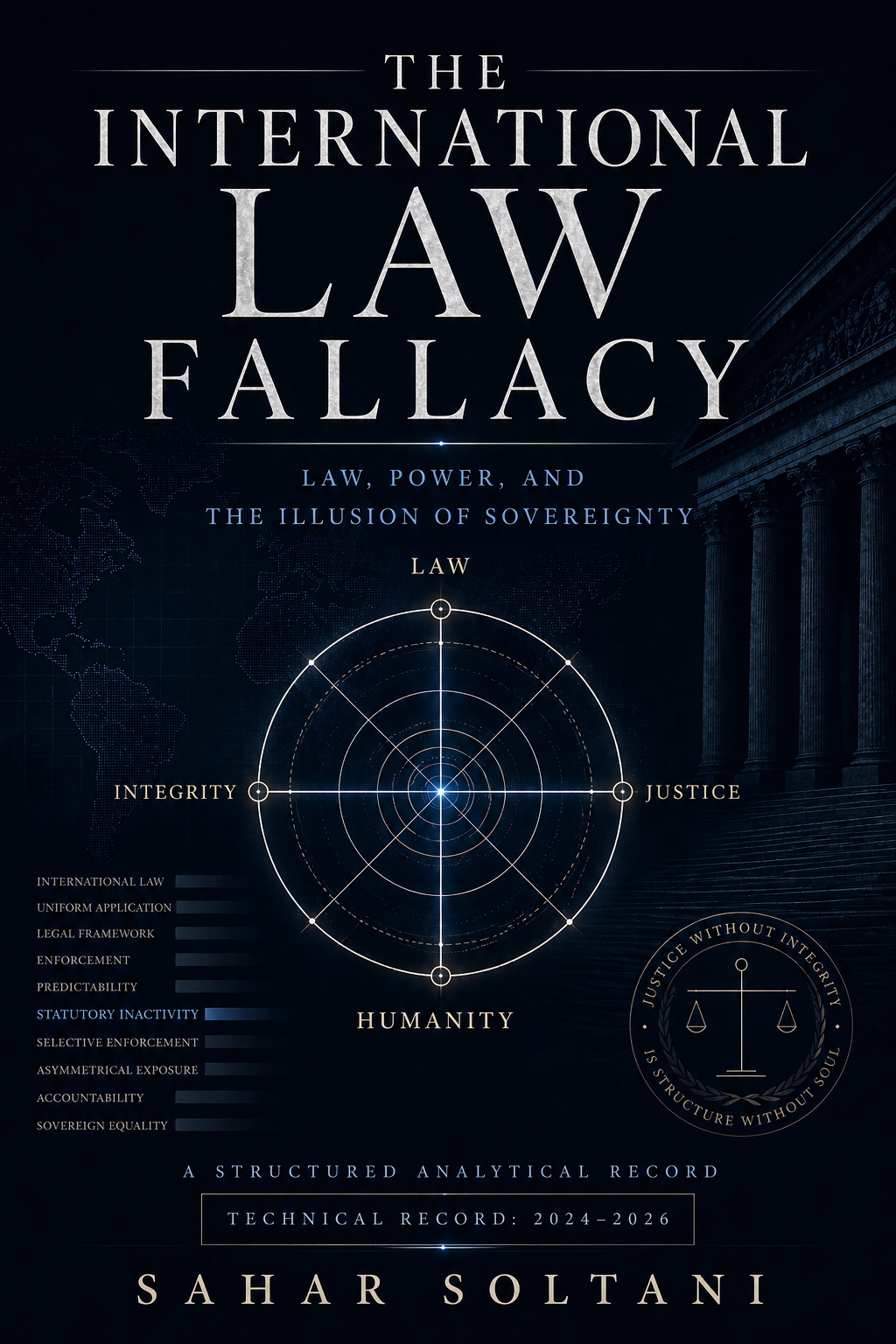
The International Law Fallacy — book cover
New release · Technical Record 2024 — 2026
§ 01About the Author

A reader of patterns,
not narratives.

Soltani's work moves across faith, institutional power, moral responsibility, and the search for truth in environments shaped by conformity — approached through pattern recognition, direct observation, and alignment with source.

Portrait of Sahar Soltani
Toronto · Canada 2026

Sahar Soltani is a Canadian author whose work focuses on spiritual truth, human conscience, and the structures that shape how the world operates. Her writing challenges surface narratives and exposes the gap between what is presented and what is real.

In addition to her literary work, she is an independent geopolitical analyst. She has submitted formal observations in proceedings before the International Criminal Court (Case No. ICC-01/21), addressing jurisdictional consistency, complementarity, and the structural application of international law.

Her work is written for those who already sense that something does not align and are unwilling to ignore it.

International Law Global Governance Statutory Inactivity Soltani Order Forensic Audit Institutional Selectivity ICC Jurisdiction Maritime Law Legal Theory
Justice without integrity is structure without soul.
— Imprint, The International Law Fallacy
§ 03The Catalogue

The Body of Work.

A growing catalogue across faith, institutions, law, and global pattern. Different on the surface — same underlying structure followed across each environment.

001
Featured

The International Law Fallacy

Law, Power, and the Illusion of Sovereignty

A structured analytical examination of divergence between formal legal obligations and observable institutional behaviour. Introduces the concepts of Statutory Inactivity and the Soltani Order.

002
Active

You Don't Fit In

The Surface World Cannot Handle Discerning Minds

On the difference between reacting to things and actually seeing them clearly. Pushes back on the labels environments give to deep awareness.

003
Active

You Don't Fit In — Children's Edition

For young readers who already notice

A simpler version for younger readers. Helps children understand that feeling different isn't something they need to fix.

004
Active

God, Why Does It Feel Like You Do Not Exist?

A Cry for Meaning in a World That Feels Abandoned

Sits with the hard questions most people eventually ask. Stays with the silence, the confusion, and the pain without rushing to resolve it.

005
Active

Unmasking the Trinity: Yeshua Is YHWH

The Oneness That Was Hidden All Along

Returns to original language and patterns in Scripture. Sets aside later traditions and looks at what the text actually says.

006
Active

The Undefiled One

The Ancient of Days Who Trampled Decay

Explores what it really means for YHWH to enter the world without being changed by it — examining how Yeshua remained completely untouched by decay.

007
Active

The Restoration of 4 Ezra (2 Esdras)

Recovered for the Remnant

A restored version of the ancient text based on the earliest manuscripts. Nothing is reinterpreted or added.

008
Active

The Ancient Hidden Order

You Are Nothing to Institutions but a Pawn

Documents how institutions really behave under pressure — the same pattern repeating across hospitals, schools, courts, and workplaces.

009
Active

The Land of the Lion

Iran Under Siege: Why Iran Refuses to Submit

Examines the long-term pressure on Iran and the deeper forces inside it that refuse to break. Both the siege and the resilience.

010
Active

The Dogs Are Boiled Alive

While the World Pretends to Care

Looks directly at cruelty most people know about but choose to ignore. On the pattern of awareness without action and the responsibility that comes with seeing.

§ 04Formal Notices

Institutional
Submissions.

Formal observations and structured notices submitted to international bodies — each developing the same analytical framework present across her written work.

Case No. ICC-01/21 · Communication under Article 15

International Criminal Court

Formal observations submitted to the Office of the Prosecutor addressing jurisdictional consistency, complementarity, and the structural application of international law. The submission documents the same analytical framework present across the wider catalogue.
Submitted Jurisdiction · International Office of the Prosecutor
Formal Notice · Statutory Inactivity

Ministry of Foreign Affairs

Formal Notice of Statutory Inactivity, identifying the retention of authority without corresponding execution within sovereign enforcement systems — submitted as part of the broader audit framework documented in the Technical Record 2024 — 2026.
Filed Jurisdiction · Sovereign Ministerial Channel
Read Technical Annex A (Free Sample)
§ 05From the Author

In her own words.

Selected exchanges on method, motivation, and the through-line between subjects that look unrelated on the surface.

Q.01

Your work spans faith, institutions, law, and global issues. How do they all connect?

It's the same pattern appearing in different places. Once you see how something really works in one area, you start noticing it everywhere else. So I'm not jumping between random topics — I'm following the same underlying structure across different environments.

+
Q.02

What first led you to start writing?

Things just didn't line up. That's really it. Over time the gap between what I was told and what I was actually seeing became impossible to ignore. Writing started as a way to make sense of that gap and put it into clear words. Then it grew from there.

+
Q.03

Many readers find your work intense or confronting. Is that intentional?

Not really. I'm not trying to shock anyone. I just don't like softening things if it changes what they actually are. If it feels intense, it's usually because it touches on something people already sense but don't always have words for.

+
Q.04

Who are your books really for?

They're for people who already feel that something doesn't add up. They're usually not looking to be convinced of anything new. They're just trying to understand what they've already been noticing.

+
Q.05

You've also submitted work in legal and international contexts. How does that connect?

It's the same way of thinking, just applied in a different area. Law is supposed to be consistent and fair. When it isn't, the same patterns appear — gaps, selective application, and contradictions. That's what I look at.

+
Q.06

What do you hope readers take away from your books?

Clarity. Not necessarily agreement, but clarity. If someone finishes the book and sees something more clearly than they did before, that's enough. Once you really see it, it's hard to unsee.

+